History of Wilford Henry Robinson
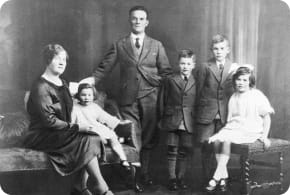
04/16/2018I, Wilford H. Robinson, was born August 9, 1903 in Laketown, Rich County, Utah, the second son of George Henry and Lucy Barker Robinson. I was the third child in a family of eight children. My brothers and sisters were Fuchsia, Vernon, Amos, Ella, Hazel, Grace, and Lucile. My father had a store and some farm land. Later he acquired an interest in a rural electric power company called Swan Creek Electric Company.
When I was six and a half weeks, Father left for the Eastern States Mission leaving Mother with three small children. His brother Joseph managed the store for him. After eighteen months, he was called home to be bishop of the Laketown Ward, and he held that position for nearly thirty years.
' *
There was about an acre of ground around our home. Our livestock consisted of two cows, some chickens, and a team of horses which we used to pull a buggy and a wagon. On our lot we had apple, pear, and plum trees and raspberry, current, and gooseberry bushes and asparagus and rhubarb plants. In the garden we raised potatoes, carrots, beets, peas, and turnips.
We had a well to supply water for the house. We'd bring it into the house in a large bucket which was set on a pantry shelf. In a room upstairs we had a large water tank. It held fifty to sixty gallons and supplied a gravity flow for the bathroom downstairs which had a bathtub, wash basin, and toilet. We boys carried water upstairs in buckets to keep the tank full. We had an outside toilet which was used most of the time; the inside toilet was used only in emergencies.
We lived in an age of labor-saving devices. I don't remember the old way of hand scrubbing clothes on a washboard. We had a hand-turned washing machine, and we boys were the power to turn it. On November 8, 1913 we got electricity. After that Mother used an electric washing machine.
While growing up I was required to help with chores around the house, and when I grew older with work around the store and farm. Some of my earliest recollections are of milking a cow, helping saw wood for the stoves which were in the kitchen, living room, and parlor and weeding and watering the garden, carrying water upstairs, and turning the washing machine.
One day I was fooling around with one of our colts and got kicked in the mouth. I got a bad cut on my lip. Mother taped it with adhesive tape which held well, and I was left with only a small scar which eventually disappeared. I also remember older boys trying to get me to fight another boy. They egged us on but didn't succeed too well.
In the summers we often went swimming in Big Creek and the lake. There was a good pond in the creek near Willis’ land that we liked. We had to walk to go swimming, and so we went to the creek more than to the lake. In the winter we went there to skate. I had a pair of skates that would clamp on my shoes. We would start walking to Big Creek, and when we came to firm ice, we would put on our skates and skate. We would also play games like run-sheep-run and kick-the-can. On Saturdays during the summer, we watched the older boys and men play baseball. We had children's books to read, and I enjoyed reading. We had a phonograph and later on a radio. Our first radio had ear phones; later we had one with a speaker. It was an Atwater Kent which I still have. Another thing, which amused us, was a Magic Lantern. It was a type of projector. You could put a postcard in the back, and it would project it on the wall.
When I was ten, Father took us children to the circus in Montpelier. Some¬times in the summer we visited in Cache Valley at the homes of Aunt Jane Kearl and Aunt Sarah Burgess. These families came to Laketown to visit too.
On my eighth birthday, I was baptized by my father in the pond where we went swimming. I was confirmed in church in the same building now in use. But in those days there were no classrooms to the south, and the heat came from coal stoves: two upstairs and one in the basement. As a boy I attended Sunday School, Sacrament Meeting, and Primary many times in this building.
I was educated in the public school at Laketown. My early education was in a two-room frame building. There were four grades in each room. During the school year, my sixth year, we moved into the new four-room brick building. The ninth and tenth grades were added; the old school was converted to a gym, and basketball became an important activity. I was on the team while in the ninth and tenth grades. We played against Garden City, Randolph, and Woodruff I played a cornet in the school band which put on programs for Laketown, Randolph, and Garden City.
In 1913 my father served in the Utah State Legislature. He rented a house at 561 11th Avenue in Salt Lake. He took Mother, Hazel, Ella, and Amos with him. Fuchsia, Vernon, and I stayed with Aunt Bee and Uncle John. After Grace was born on January 23rd, I got to go and stay with the family for awhile. Father moved the family home on March 1st. Evidently Amos and I had been exposed to measles in Salt Lake for we broke out with them soon after coming home. We exposed the rest of our family and a number of children in the town. There were so many cases of measles that Sunday School and District school were not held for awhile.
Evidently I had a few health problems. In Father's diary of 191^ he writes, "Wilford Is ailing some." On July 5 he says, "Wilford is troubled with his feet swelling so he cannot walk." Then on July 26 he records, "Wilford is still ailing, The doctor says tuberculosis is commencing in one lung." I remember climbing on the coal shed and from there onto the roof on the old garage where I'd lie in the sun with my shirt off. I am not sure how long it was until I recovered.
During the summers I clerked in the store, helped to stock the shelves, and worked on the farm. One day a customer from Meadowville brought a note from his neighbor who had a charge account at the store which read, "Please send me a plug of chewing tobacco." It was signed, "Your dear brother in the Gospel" and then his name. Another time a man came in and asked for a plug of tobacco to be cut into small pieces for his sick cow. Later we found out that he did not have a sick cow. He was a member of the Sunday School superintendency. In those days it was hard for the older men to give up the chewing of tobacco.
Another job I had was taking care of the Recreation Hall above the store. I kept a supply of coal and wood for the stove, did the cleaning, and sometimes collected tickets. It was used for local programs—both church and school, dances, and traveling stock companies. After the programs I had to check the fire, turn out the lights, and lock up.
Sometimes customers of father asked me to help with their haying operations. The wages I earned when working for others were always paid to my father. When older I drove the truck to Evanston, Wyoming for Father. The customers would often bring eggs packed in oats to keep them from breaking. My job was to get them out of the oats and pack them in cases where they could be counted easily. We took the eggs along with apples, cherries, and raspberries to Evanston and brought back merchandise for the store. I also drove a truck part time for Mr. Joseph Moffat who sold produce in Evanston and Kemmerer. Even after I went to school in Salt Lake, I helped Father during the summer.
In 1920 my father bought a home at 626 South Twelfth East in Salt Lake so that Fuchsia, Vernon, and I could go to school there. Fuchsia and Vernon went to the University of Utah, and I went to the L.D.S. High School. I attended there for two years and used the street car for transportation. While there I took a woodwork class and made a table and bookcase that the family used for many years.
I enrolled at the University of Utah in the fall of 1922. At that time my major was economics. The second year I took chemistry to fill a group require¬ment. After that I decided to major in chemistry. Changing majors delayed my graduation; I had the necessary hours but lacked hours in chemistry. I went to school in the summer of 1926 to finish my requirement for graduation. I was not officially graduated until the spring of 1927. at which time I received a B.A. degree with a major in chemistry.
During my first years I tried out for the football team but was too small and didn't make it. My last summer there I got a job as a janitor cleaning one of the buildings. During the years I lived on Twelfth East, Amos and Ella came to go to school; Fuchsia graduated; and Vernon left for a mission to England.
We lived in the Emigration Ward. I don't remember much about going to church, but I did go to Mutual and played "M" basketball. I think of the difference be¬tween me and my boys. I never dated a girl while going to college. I did not have the money or a car. I had my first date while working for the American Smelting and Refining Company.
In the fall of 1926 I got employment at the American Smelting and Refining Company at Garfield, Utah. I got a room in a house on the avenues and took a train each day to Garfield. My work was in the smoke-testing department, test¬ing effluent gases leaving the refinery. Part of the time I worked on what were called roasters. The sulphur fumes were very strong, and I wore a mask to protect me from the fumes. The mask was not too effective, and I suffered from nose bleeds and coughing all the time I worked on the roasters. Later I worked in the laboratory.
At that time the work situation was unsettled, and so in February of 1927, I and a fellow worker decided to look for jobs in California. He had a brother-in-law working at the Ogden Stock Yards who lined us up with a job taking care of cattle in a cattle car going to Los Angeles. Rains washed out part of the rail¬road bed in California, and so we were held up in Los Vegas for a day or two while the roadbed was fixed. We visited the Los Vegas night life which is quite different from what it is today. After arriving in Los Angeles, we did a little sightseeing for a couple of days before starting to look for work.
We found the job situation in Los Angeles was not too good either. After a time, we got a job in the labor gang at the El Segundo Oil Refinery of Standard Oil Company and got an apartment in El Segundo. We had worked there for about two weeks when a "gas war" started. Standard Oil laid off wholesale, and we were among those laid off. Then came another period of job hunting. My friend finally got a job in northern California. After trying all the oil companies in the Los Angeles area, I decided to try the place where my friend had found a job. Since I had at least an hour to wait for the next train to Los Angeles, I decided to make a second try at Shell Oil Company which was nearby. This time there was an opening in the laboratory, and I got the job. Thus began my twenty-year career with Shell Oil Company.
Since we had the rent paid on the apartment in Los Angles, I stayed there until the rent expired. My money was getting low; I managed to eat for less than a dollar a day. I went to an eating place that catered to low-income people. You'd go to a counter, select your food, and then eat at a chair with a side arm.
After I got my first pay check, I moved to a family-type hotel in Wilmington. One of my fellow workers, Glen Flickinger, lived there too. We became buddies and played tennis and did other things together until we were separated by transfer within the company.
During the next few months I worked in the laboratory testing petroleum pro¬ducts. The refining of petroleum is a continuous process, and the testing of the products is also. I worked shift work seven days a week. After several months, there was a change in the laboratory work; it looked as if I might get laid off. However, there was an expansion in plant operations, and I was transferred to the Dubbs Cracking Plant operation. I still worked shift work, but sometime later we went to a six-day work week. Later I was transferred to the Dominguez plant in the same department. The Dominguez plant was about three miles from the Wilming¬ton plant, and not readily accessible to public transportation, and so I purchased a used model-T Ford coupe. I worked in the cracking plant for a little over two years, and in that time worked up from pump house gages to Dubbs plant operator.
The Dubbs Cracking plant operated on a residual oil that is left over after the lighter fractions have been distilled off. In the cracking process, the residual oil is heated to about 850° Fahrenheit and to a pressure of about 120 pounds. In this process the oil is broken into lighter fractions and a heavier residual which are separated. There is an element of risk in this operation. There are periodic shutdowns for inspections to minimize the risk.
One night a line on one of these cracking units ruptured and caught fire. In the ensuing fire, five men were burned, and all of them died. I was operat¬ing this particular unit several hours before the fire broke out. My relief, the one who took over the operation of this unit when I left, was one of those who died. I missed this accident by about five hours.
I got my first vacation in the summer of 1928 and went home for a visit. While there I looked up a girl I had met my last year at the University and had a date or two with her. I had dated her a few times while I was working at the American Smelting Company before leaving for California. After my vacation in Utah, I corresponded with her the next year. The following year, while home on vacation, we dated a few more times; but before I went back, we decided to break up.
While working at the cracking plant, I took a course in First Aid. I was selected to become a member of the company's First-Aid Team. We competed with teams in the Los Angeles area, and our expenses were paid to San Francisco so we could compete in a contest there. I was awarded a First-Aid pin for competition in this activity.
Sometime after the fire at the cracking plant, I was transferred back to the laboratory where I still did shift work. I worked in the laboratory until I was transferred to Ventura. After working in the cracking department for about a year, I moved to a boarding house in Long Beach located on the ocean front. I went swimming in the ocean regularly. There were more than a dozen people living there, and the chief diversion was bridge, and so I learned to play bridge. While I was living there, I traded my Model T in on a new Model-A Ford Coupe.
I met Sophia Hefty at the boarding house and started going with her. She was born in Bellingham, Washington, and was the daughter of Casper and Susanna Zurbrugg Hefty. Her parents were born in Switzerland. She was educated in the public schools of Bellingham and graduated from Washington State Normal College there. I do not know whether she taught school in Washington, but she did teach in Arizona. Her sister Clare taught in Long Beach, and so Sophia eventually moved to California to teach. She went to the University of Southern California to obtain a California Teaching Certificate. When I first met her, she was teaching in Wilmington.
I had only one or two dates in California before I dated Sophia, In Wilming¬ton my diversions were playing tennis and watching the large ships loading and un¬loading cargo at the docks. In Long Beach I played bridge and tennis and went swimming in the ocean.
On July 9, 1930 Sophia and I were married in a Presbyterian Church in Long Beach. We left a few hours later for a week's honeymoon at Lake Tahoe in Califor¬nia. , When we got back, we moved into an unfurnished apartment and started buying furniture. Sophia continued to teach.
In 1931 Vernon went to summer school in Los Angeles and visited with us on week-ends. His fiancée, Berlin Garrett, also was in Long Beach visiting relatives. When I got my vacation in August, Sophia and I acted as chaperons for Vernon and Berlin on a trip to the Grand Canyon and Salt Lake. While at the South Rim, we took a mule-train ride down to the bottom of the canyon. Then we drove on a road that was little more than a trail, across the Painted Desert to the crossing of the Little Colorado at Cameron. We continued north and crossed the Colorado at Lee's Ferry Bridge. We drove to Salt Lake by way of Kanab and Richfield. Father, Mother, and Lucile came from Laketown to visit with us. It was the first time they had seen Sophia. Sophia and I went back to California by the way of Zion National Park.
Soon after my vacation, we moved into a larger apartment and bought more furniture. We also started buying a lot in Long Beach on which we planned to build a home later.
In 1932 I was transferred to Ventura, California. My work was testing water-content of crude oil in the laboratory there. The work was not too technical, but since the company had been involved in law suits regarding some of their testing methods, they wanted a trained technician to do the testing. The owners of the land leased by the oil company had the right to inspect the testing done by the oil company. Later I did water analysis on the water from the oil wells.