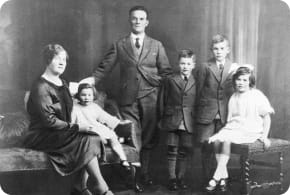
Louisa P. Nielsen

BillionGraves GPS Headstones

Memorial record from BillionGraves GPS Headstones honoring the life of Louisa P. Nielsen (1879 - 1927). Interred at Wellsville Cemetery in Wellsville, Utah, United States. View headstone images, read their story, and connect with family members.

Tombstone marking the grave of Louisa P. Nielsen who lived 1879 - 1927, located in Wellsville, Cache, Utah, United States at Wellsville Cemetery

Record Info

Given Name: Louisa P.
Last Name: Nielsen

Finding more about Louisa

BillionGraves burial location map for Louisa P. Nielsen at Wellsville Cemetery

Every image taken by the BillionGraves app includes high precision GPS coordinates. Tap below to see the GPS location of this grave.

Nearby Graves

Loading

We found loading nearby graves using the high precision GPS coordinates included with every BillionGraves image.

    Other Info

    View on FamilySearch

    Contributors

    Memories

    A History of the Clan by Sophia Critchlow

    04/18/2018
    And so it is with family's no beginning and no end. Dad, W.L. Nielsen Sr., was born in Hyrum, Utah. Grandma Halvorsen Nielsen was a very sedate, strict lady. Second wife in a polygamist Family. Mother, Louisa (pronounced loo Wise) was born in Wellsville, Utah. She came from a Polygamist family. Her mother, Grandma Leah perks Poppleton walked across the plains with a handcart group. She was 14 years old when she became Grandpa Poppleton's third wife. Most of the Poppleton's settled in Wellsville, Utah. The Nielsens lived in Hyrum, Utah. As Wilford and Louisa grew, their social life centered around the L.D.S. Church. Grandma Halvorsen Nielsen, was a nurse, midwife. As such she was on call 24 hours a day. She owned a very fine buggy and horse. Occasionally Dad was allowed to use this outfit as a "Courtin Car". Mostly he rode a horse, bareback. So on a Summer Day, he saw Louisa at a picnic. She was young and very pretty, Dad couldn't stay away from her. The Farm at Greenville, became his place (a suburb of Wellsville) to visit. He hung around the Poppleton house, getting under Grandma Poppleton's feet for over a year. In the meantime he was also getting older. A job in Park City became available to him, so Dad took it. This was really a step up, financially. It meant ready cash every week and Dad was a saver. He loved Louisa and so he showered her with many gifts. Once a month he came back to Cache County. He came home for Christmas 1889, the roads became impassable and he couldn't get back into Park City. Mother had been preparing a trousseau for a long time. She and Grandma had made quilts and all kinds of household linens. Everything was monogrammed. Lavish Crocheted lace was put on sheets and pillow cases. Mothers clothes were handmade also. Underwear was made from fine linen with tucks and lace and ruffles. Almost everything was white. Ladies wore white under their dresses. Petticoats had many tiny tucks and wide lace in rows around the bottom. Since everything seemed to be in order, they decided to get married after New Years. The wedding took place in Hyrum on January 2, 1900. Grandma Nielsen took charge. She was a take charge lady, and she had the biggest house. The third week in January the roads opened up. The trains began running and the new Mrs. W.L. Nielsen boarded the train at Cache Junction, North East of Logan. Bag and baggage, a new husband, a new life, she was on her way to Park City. She was busy getting settled in her new home. Dad had rented a small house and with all the nice things mother had brought along with her, the house became a home. That summer in Park City was a honeymoon. The only time in their life that they were alone together. Dad worked in the Silver King Mine. Things seemed to be ideal! They had lots of money, a nice place to live, very much in love and their first child was on the way. The day after Thanksgiving Grandma Poppleton arrived. It was always good to have your own mother around to help usher in your first born. Christmas was coming and still no baby, Wilford took his time. But on the 20th day of December, Mother went into labor. The doctor was called and six hours later Wilford Lewis Jr. was born, a healthy hungry boy. It seemed like Dad and Mother had the world by the tail, and they were pulling down hill. Dad was making good money, they had moved into a larger house, the baby was growing. Then came tragedy, Dad became ill. Mom doctored his lungs with mustard plasters. He began to miss work. He would feel better and just get back to work and he would be sick again. Finally Grandma Nielsen took a hand in it and insisted he go to Salt lake to a doctor she knew. He was diagnosed as having been leaded. His body had absorbed a lot of lead from the mine. The verdict was get out of the mine or die. Mom and Dad packed up everything and moved back to Hyrum. Under Grandma Nielsen's care Dad got better. He did farm labor and soon became healthy. Things were looking up, they had their own house, Dad had a job and there was another baby due. Vernon P. Nielsen arrived in November and what a handful he was. Wilford was two years old and such a charmer. Always polite, always clean. He was blonde and blue eyed. Everyone's favorite. Mother had shortened Wilford's dresses. He was a toddler. He spoke very plain. No nonsense baby talk for Wilford. Vernon was darker in coloring, both skin and hair. He had colic and screamed for three months. Then he started to cut teeth. At six months he became mobile. In those days babies were kept in a room apart. They were fed, bathed and dressed in dresses three feet long. Vernon fought those long dresses, refused to stay on the bed. Mother would find him all in a tangle on the floor. Screaming lustily. He soon began to move about, expanding his territory. Things began to topple over, nothing was safe from his inquiring fingers. Even worse, he talked at a very early age. His words came out all garbled. Everyone said he sounded like a Dutchman. Thus he was nicknamed "Dutch" until his death in 1981. Vernon was "Dutch" Nielsen. In 1903 a new job opened up in Pocatello, Idaho. Dad took it and moved Mother and the two boys in to Pocatello. Mother was delighted, her favorite sister Rachel Poppleton Swallows lived there. It was here that Katie Mildred Nielsen was born. She was only three pounds at birth. She was wrapped in cotton batting and placed in a shoe box on the oven door ( an improvised incubator). It was December 4, 1904 and two cold for tiny babies to survive. But she did!! She grew, she turned out to be a fun person. She was always happy. She loved people and did many, many kind and generous deeds in her lifetime. The job in Pocatello didn't pay enough money for a growing family. so, it was back to Wellsville, Utah. It was here in Wellsville that Thelma Leah was born, September 4, 1906. It was in the fall, winter came early and thelma got sick. She was always sick. It was hard to keep her in school. Mother spent many sleepless nights, nursing Thelma back to health. No job seemed to pay Dad enough money to keep him in Welsville. He heard of a business opportunity in Ely, Nevada. "The Idaho Barn", Dad's pride and joy. He had a very successful business going, he rented carriages and hauled freight. Dad owned two large cars. They were called "Touring Cars". He made many trips across the desert Salt Flats in those two cars. At times the heat was so intense that the tires blew out on the car. It wasn't unusual for Dad to replace an inner tube with a large quilt or lap robe and bring himself into Ely. Mother really enjoyed the prosperity in Ely. she even had household help. A black women named "Irene" became a servant and friend to Mother. Mother and Irene were noted for the beautiful cakes, mother served to the society ladies of Ely. Mother was hostess to many afternoon socials and tea's. These were very elegant and elaborate, with fancy food and a young lady soprano to entertain the ladies. Mother had three more kids while in Ely. . Rhoda, July 6th 1910; William, January 26th 1914; and Alberta, September 29, 1916. Wilford, Dutch and Katie were considered young adults, and they were given jobs around the house and in the business. Mother loved to dance. Dad never learned how, so Mother took Wilford to all social functions and taught him to dance. Thelma finally passed from the effects of Rheumatic Fever. She was buried in the Ely Cemetery. By 1917 people who could afford to hire a carriage could afford to buy a car. Once more Dad pulled stakes and moved back to Wellsville. Mother went to the cemetery to bid Thelma goodbye. She cried because the grave was unmarked by a permanent headstone. She would have been so proud and happy if she had known that many years later her baby, Harold would go to Ely and place a lovely stone on the grave of a sister he never knew. Mother buried Thelma in 1916 in Ely and Alberta in 1917 in Wellsville. Babies were so frail in those days, and there were so many germs that mothers never knew about. So many diseases, with nothing to treat them. Dad went into the contracting business in Wellsville. He helped build roads, and bridges, he dug basements. Anything at all to support an ever growing family. Three more babies were born in Wellsville. Sophia in February 11th, 1918; Edward, September 29th, 1920; Harold, January 22nd, 1922. Edward contracted whooping cough and died. He was just one year old. This left Mamma's Brood at seven. Wilford married his first wife Harriett Gittens in 1921. so the family began to grow with a second generation. In late 1922, Carbon county, Utah was crying for able bodied men to work in the coal mines. So once more everyone migrated, this time into a mining town, named Spring Canyon. This was to be Dad and Mother's last major move. Carbon County became our home. Here we put down our roots and claimed it as our own. Dad and Wilford came first. They went to work inside the mine. They rented houses near each other and got ready to bring their families into Carbon County. Mother came next, Dutch had stayed home to help mother. There was much packing and so many young children to get ready. This was the last major move in Mother's life. We arrived in Spring Canyon by train. dad had arranged for a man with a large car to take us to Salt Lake. Another car met the train and took us to the Spring Canyon Boarding House. The men were just coming off shift from the mine. Everyone was covered with coal dust. I had never seen a black man in my life. so I immediately went into hysterics. Dragging little brother with me, I hung to mothers skirts and screamed. This was the first of many surprises we had in store for us. Until now we had lived in strictly Mormon environment where people were mostly of Scandinavian decent. They were mostly blonde and blue eyed with fair skin. Suddenly our world became an ethnic community. so many nationalities. Japanese, Korean, Italian, Austrian, Mexican, Greek and a spattering of Jews. There were also some Danish, English and Norwegian. Each of these cultures lived in their own section of the town. Each followed their own religious beliefs and cooked their own native dishes. The Mormons had established a church, so we were soon caught up in this social circle. Our house was a mile from the center of the town. The town consisted of a school and a church house. These two buildings doubled as a town meeting house. We went to school, attended church, had movies, dances, weddings, funerals, all community affairs were conducted here. There was a company store, a post office, a confectionery, also the mine office. The mine office was up a large flight of stairs that ran up the outside of the building. The men would go up one side, pickup their pay envelopes, and march down the other side. Never going inside the office. to be summoned to the office, meant you were in trouble. We soon learned that living in an ethnic community wasn't half bad. We learned to eat and enjoyed their cooking. The pastries some of these ladies turned out were real-melt-in-your-mouth delicacies. Their children were beautiful and clean, well mannered and polite. We ran in and out of their homes and were soon unaware of the difference in our skin color or nationalities. By this time Harold had become "Pudge". He and I were the youngest. We adjusted very well to our new home. Mother really missed her own people. she longed for her mother and her favorite cousin, Annie Poppleton. Aunt Rachel, mother's sister in Pocatello had passed away by now. so we claimed Annie Poppleton as our won favorite aunt. Actually she was a cousin. At least once a year and sometimes more if we were lucky, Dad would load us into the car and we would go to Cache Valley to visit Aunt Annie and Uncle Will Poppleton. It took us two very long days. We packed our own food and water with us. Our first night away from home was spent in a hotel in Salt Lake City. There was nor air conditioning so we opened the windows. "Pudge" and I would hang out the window and watch the traffic below. sometimes Rhoda and Bill would join us but they were growing up, and really tried hard to maintain a good image. The second day took us into Wellsville. The roads were better in this part of Utah, so we made better time usually arriving at Aunt Annie's in the afternoon. Mother and Aunt Annie had their kids almost the same years, so there was a playmate for each of us. It was a wonderful time in our life. But four our Mother it was to be a short time, Mother only lived four years after the move to Spring Canyon, Carbon county. Dutch had taken Mother to a show in Helper. She became ill and he brought her back to the company Hospital in spring Canyon. she was there about four days. Then they brought her home. That fall and winter were to be the worst in our lives. Our "Mama" was so sick. she had cancer and the pain was almost too much to bear. She struggled with it all winter. Never getting better only a little worse each week. Grandma Poppleton had died 14 months before. Mother had really grieved over losing her Mother. She could not go on. so in April of 1927 we took our Mother back to Wellsville to bury her in the same cemetery with her Mother and her two babies Alberta and Edward. Life in Spring Canyon went on for Dad and the rest of us. dutch had married Fern and they had already had two children. Katie married Gerald the May after Mother died. She moved into her own place. Rhoda, Bill, Pudge and I were left alone. So we formed a very close group. Dad worked so we were left pretty much to our own devices. There were times when we got into mischief, but for the most part we just grew up. In 1931, Rhoda married Tino and in 1932 Bill married Anne. This left Pudge and I alone together. We taught ourselves to cook and clean house. We did our own laundry. we hardly ever got sick. We went to school, and learned our three R's. By this time we were 12 and 14 years old. We felt very grown up and we were. we went to school all week and cleaned house and washed clothes all weekend. Once more Dad made a move. He left spring Canyon and moved to Helper. I was dumped on katie and Gerald. so our lives began to go down different roads. Dad leased a farm and did farm work for a few years. Then moved into another farm house. Bill and Annie lived in the same house for a year or so. We did what we always did when the going got tough. We got up in the morning and found another job. We worked at anything that paid money. In the thirties times were tough. I went to work in the Standard Store. I was seventeen and holding down a job that an older woman had done before me. i worked from seven o'clock in the morning until seven o'clock at night, for 50 dollars a month. The Banasky's made a move, so I went along. In Latuda, Banasky made 300 dollars a month. What a fortune. We were rich. Katie wasn't well so I stayed home with her and helped out with her two boys. In 1940 John Critchlow came along, we were married in July. I moved to Price. Pudge worked in a grocery store in Helper called Ricci's market. He had learned his first trade. He was a Butcher and a good one. Things looked better for all of us. Dad lived until 1961. he died in September. We took him to Wellsville and buried him next to Mamma. It was Pudge who went to Welsville later and put headstones on the family graves. The Nielsen Family has come a long way since we arrived in Helper with one suitcase apiece. None of mamma's Brood ever made it through high School. But we got her grandchildren through some form of formal education. In the Nielsen Family there are, accountants, executive business men, lawyers, nurses, salesmen, secretaries, cosmetologist, newspaper people, teachers, ranchers, miners, truckers and technicians. /we do everything well. Many own their own businesses. We own homes, cars, trailers, vans, land and boats. some have traveled all over the world. We have people in the Army, Navy and Air Force. There are politicians, we sit on city councils and county commissions. We have chaired Fund Drives for many charities. We have been presidents and leaders of many service clubs, Rotary, Elks, Lions, Masons and Kiwanis. We are church going people. There are Bishops and Primary teachers. We sing in church choirs and act as Den Mothers for Scouts. We are Catholic, Seven-Day Adventist, Christians, Mormons and Presbyterian. And so it is and always should be: I leave the legacy to some future historian to tell the reat of a never ending story. Aunt Skeets

    BillionGraves GPS Headstones

    What is the BillionGraves App Headstone Collection?

    The BillionGraves App Headstone Collection contains photos of gravestones taken by volunteers with the BillionGraves app in cemeteries around the world. The names, dates, and other information have been transcribed and are searchable.

    Each gravestone photo has been tagged with GPS coordinates and the locations are plotted on a cemetery map.

    What genealogical data can I learn from the BillionGraves App Headstone Collection?

    The BillionGraves App Headstone Collection records may include:

    • First name
    • Last name
    • Age at Death
    • Spouse
    • Gender
    • Occupation
    • Names and relationships of family members
    • Clubs, hobbies, organizations, and interests
    • Religion
    • Burial Location and Cemetery
    • Military Information
    • Birthplace or Country of Origin

    The BillionGraves App Headstone Collection also shows nearby gravestones. Since 70% of people are buried in family plots, this can reveal even more family relatives.

    What years does it cover?

    The BillionGraves App Headstone Collection spans from about 1600 to the current day.

    Source Citation

    BillionGraves GPS Headstones Louisa P. Nielsen (1879 - 1927) https://billiongraves.com/grave/Louisa-P-Nielsen/4397378 BillionGraves.com

    Adjacent Records

    8 Records

    These records were created in the same area as this record.